
Finish Carpentry · Naperville & DuPage County
Crown Molding Installation in Naperville, IL
Room crown, built-up crown and cabinet crown — with coped corners that stay tight.
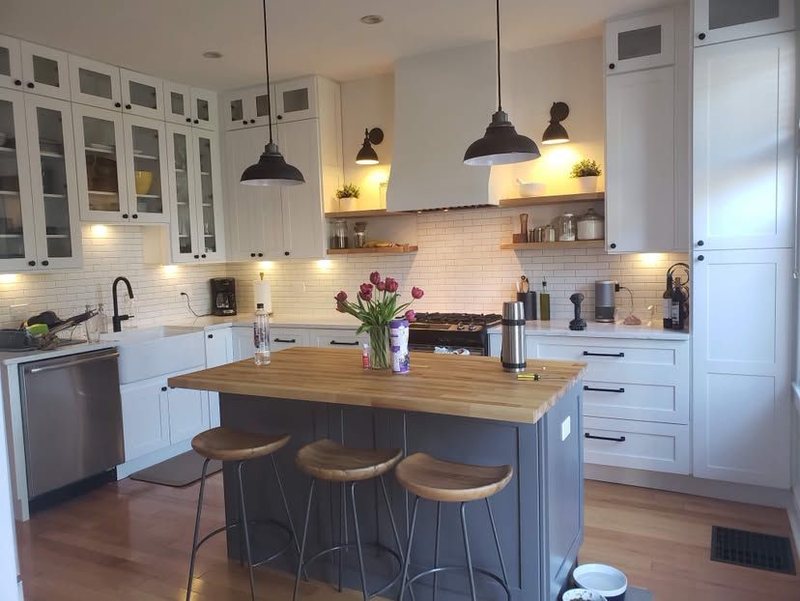
Crown molding for DuPage County and Chicagoland homes
Crown molding is the trim where the wall meets the ceiling. It covers the joint, draws the eye up and makes a room look finished. We install crown in living rooms, dining rooms, bedrooms, hallways and kitchens, and on top of kitchen cabinets as part of a cabinet installation.
Crown molding is one part of our finish carpentry work, alongside wainscoting, baseboards and built-ins.
Choosing a size
Crown should be sized to the ceiling. As a rough guide, smaller crown of about 3 to 4 inches suits 8-foot ceilings, and larger crown of 5 inches and up suits 9- and 10-foot ceilings. Very tall ceilings and formal rooms often get a built-up crown: two or three pieces of trim combined into one larger profile. The style should also match the rest of the trim in the house.
Why crown is the hardest trim to install
Crown sits at an angle between two surfaces that are rarely flat or square. Ceilings dip, walls bow, and corners are often more or less than 90 degrees. Inside corners are coped — one piece is cut to the exact shape of the other — so the joint stays tight as the house expands and contracts. Outside corners are mitered and glued. Where the ceiling is uneven, the crown is set to a straight line and gaps are scribed or filled so the line looks clean from the floor.
Crown on kitchen cabinets
Cabinet crown finishes the top of the wall cabinets. It can stop at the cabinets or run up to the ceiling to close the gap above them. When cabinets go all the way to the ceiling, a small crown or scribe molding covers the joint where the cabinet meets an uneven ceiling. This is usually decided when the cabinets are ordered on a kitchen remodel.
Crown in older homes
Many older homes in La Grange, Western Springs, Beverly and Lincoln Park have plaster walls and ceilings that are far from flat. Crown helps hide those waves, but it has to be fastened into framing behind the plaster, and the layout has to account for how much the ceiling moves along each wall.
Paint and finish
Most crown is paint-grade, usually painted the same color as the rest of the trim or the ceiling. Nail holes are filled and the top and bottom edges are caulked so the crown looks like part of the room, not something added on. Stain-grade crown is used when it has to match existing stained woodwork.
Crown Molding questions
What size crown molding should I use?
It depends on the ceiling height and the style of the house. Smaller crown suits 8-foot ceilings; larger or built-up crown suits taller ceilings.
Can you install crown on a vaulted or uneven ceiling?
Uneven ceilings are common and can be handled with layout and scribing. Vaulted ceilings need a closer look; send us photos.
Do you add crown to existing kitchen cabinets?
Often, yes, if the cabinets have a frame or top that the crown can be fastened to. Send us a photo of the top of your cabinets.
Why do crown corners crack?
Usually because the inside corners were mitered instead of coped, or the crown was not fastened well. Coped corners stay tighter over time.
Can crown molding be added to just one room?
Yes. Many owners start with the living room or dining room.
Our process
- Photos. Text us photos of the room so we can see the walls, ceilings and existing trim.
- Walkthrough. We visit, measure and talk through the look you want.
- Estimate. You get a written estimate that lists what is and is not included.
- Install. Trim is cut and fitted on site to your walls, then fastened, filled and caulked.
- Final walkthrough. We go over the finished work with you.
We serve these areas
Crown Molding is available across our service area, including:
Planning a kitchen or bathroom remodel?
Call or text us to set up a walkthrough. Send a few photos of the space and we will come prepared.